Most advice about hard feelings boils down to one idea: get rid of them. Think positive. Push through. Distract yourself. And if that has ever worked for you for longer than an afternoon, you are luckier than most. ACT takes a different road. Instead of fighting thoughts and feelings, you learn to make room for them and still do the things that matter to you. ACT therapy worksheets turn that idea into short, practical exercises you can do at a table with a pen.
Here is a plain-language tour of the main ideas, six exercises to try, and a big printable bundle on Taskdale if you want the full set.
Note: this is general self-help information, not professional advice and not a replacement for therapy. If you are in distress or at risk, please contact a qualified professional or a local crisis service.
Quick picks
| Product | Best for | Price | Link |
|---|---|---|---|
| Steady Ground ACT Therapy Worksheets Bundle | A full set: 320 pages, 10 workbooks, 48 metaphor cards | $19.99 | View |
| Inner Compass Self-Discovery Workbook | 72 core values cards for the values step | $3.68 | View |
| Rooted in Me Self-Discovery Workbook | Values and boundaries for adults | $4.99 | View |
What Is ACT, in Plain Language?
ACT stands for Acceptance and Commitment Therapy. Say it as a word, “act,” not as letters. The name hints at the whole approach: accept what you cannot control, and commit to action guided by what you value.
Picture a bad morning. You wake up anxious about a meeting. The usual response is to argue with the feeling: “Stop it, you’re being silly, calm down.” The feeling, of course, digs in harder. ACT suggests another move. Notice the anxiety. Name it. Let it ride along. Then go to the meeting anyway, because doing well at work matters to you.
That is the heart of it. You do not wait to feel ready. You carry the feeling and walk toward what counts.
ACT is built on six linked skills, and most ACT therapy worksheets are organized around them:
- Acceptance: making room for feelings instead of fighting them
- Defusion: stepping back from thoughts so they grip less
- Present moment: coming back to what is happening now
- Self as context: seeing yourself as more than your thoughts
- Values: knowing what matters to you
- Committed action: taking steps that fit your values
Sounds like a lot of jargon. It is simpler in practice, as the exercises below show.
Defusion: Getting Some Distance From Your Thoughts
Defusion is the skill most people find odd at first, and then most useful. The idea: a thought is a thought, not a fact and not an order.
Say your mind announces, “I’m going to fail this.” Fused with it, you treat it like a weather report you must obey. Defused, you say, “I’m having the thought that I’m going to fail this.” Same words, slightly different stance. The thought becomes something you watch rather than something you are inside.
It feels a bit cheesy the first time. But try it for a day. Add “I’m having the thought that” before your harshest lines and see what shifts. Many people find the thought loses a little of its bite.
Another playful trick: sing the thought to the tune of “Happy Birthday.” Silly, yes. It is meant to be. Hearing a scary sentence in a goofy voice reminds you that it is made of words.
Six ACT Therapy Worksheets to Try on Plain Paper
These are general exercises in the ACT spirit. Use a notebook. Do one or two per week.
1. The struggle log
Write down something you have been fighting, whether a feeling, a memory or a worry. Under it, note what you tried to do to get rid of it, and whether that worked in the long run. Most people see that the struggle itself costs time and energy, and the feeling returns anyway.
2. Thought labeling
For ten minutes, write each thought that comes up and put a label on it: worry, judgment, memory, plan. You are not arguing with any of them. Just sorting. It builds the habit of noticing instead of reacting.
3. Leaves on a stream
Picture a slow stream. Each thought lands on a leaf and floats away. When you get hooked on one, gently return to watching. After five minutes, jot down what you noticed. Nothing here requires you to empty your mind. The skill is in coming back.
4. Values in each life area
Take five areas, say family, work, health, friends and personal growth. For each, write one sentence about how you would like to show up. Not goals. Directions. “I want to be a patient parent” is a value. “Get the kids to bed by eight” is a goal that serves it.
5. The gap check
Rate each area from one to ten on how closely your recent actions match your values. Look at the biggest gap. That is where a small action will matter most.
6. One small committed action
Choose one tiny step that fits a value, with a day and time. Ten minutes of walking for health. A short call for friendship. Write down what feeling showed up and if you did it anyway. That last part is the point.
Why ACT Therapy Worksheets Suit Busy People
Several things make ACT therapy worksheets easy to fit into a normal week.
They are short. Most exercises take ten to fifteen minutes. You do not need an hour of quiet or a candle.
They are concrete. Instead of “work on your feelings,” you get a specific prompt and a space to write. When you are tired, a prompt is easier to follow than a vague intention.
They do not ask you to feel good first. A lot of self-help assumes you must be in a good mood to do the work. ACT assumes the opposite: you can start on a bad day, because the work is about moving with the feeling, not removing it.
And they build on each other. Defusion helps with acceptance. Acceptance frees you to act on values. Even a few pages in, you can feel the pieces connect.
A word of care though. Some feelings are too heavy for a worksheet to handle alone. If you are dealing with trauma, long-lasting low mood or panic, a trained therapist can guide ACT work much more safely than a workbook can. Many therapists use ACT worksheets themselves in sessions.
A Day With ACT Worksheets: What It Looks Like
It helps to see how the pieces fit into a regular day, so here is an invented sketch. Marcus dreads Sunday evenings because the work week looms. He starts a ten-minute habit after dinner.
On the first Sunday he does the struggle log. He writes that he has spent two years trying to talk himself out of the dread. Nothing worked. Seeing “two years” on paper is a small jolt. On the second Sunday he tries thought labeling and notices most of his Sunday thoughts are plans or worries, not facts. On the third, he uses the values sheet and writes that he cares about doing good work and being home for his kids.
By the fourth week he picks one committed action: closing his laptop at six each evening. The dread still shows up on Sundays. But now it sits in the passenger seat instead of driving. Nobody would call that a dramatic transformation. It is a slow and steady shift, which is the usual shape of this work.
The lesson in Marcus’s story is the order. He began by noticing the struggle, moved to watching thoughts, found his values, and only then took action. Skipping straight to action without the earlier steps tends to feel like forcing yourself. Doing them in sequence makes the action feel like a choice.
The Steady Ground ACT Bundle and Related Workbooks on Taskdale
If you would like pages ready to print, here are three options from Taskdale. All are PDFs.
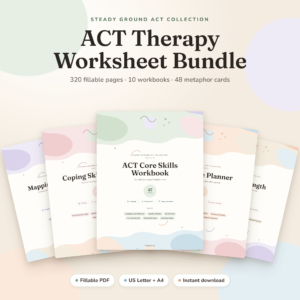
Steady Ground ACT Therapy Worksheets Bundle
Price: $19.99 | Best for: a complete ACT toolkit
A bundle of 320 fillable Acceptance and Commitment Therapy pages, made up of 10 workbooks plus 48 ACT metaphor cards. It covers values, defusion, mindfulness and coping skills, as US Letter and A4 PDF. The best fit if you want every ACT skill in one purchase, or if you are a helper who needs a deep library of pages.

Inner Compass Self-Discovery Workbook
Price: $3.68 | Best for: the values part of ACT, on a small budget
A 105-page fillable and printable Who Am I journal with 72 core values cards, plus self-esteem and identity worksheets, for teens and adults. US Letter and A4 PDF. The values cards can feed straight into exercise four above.
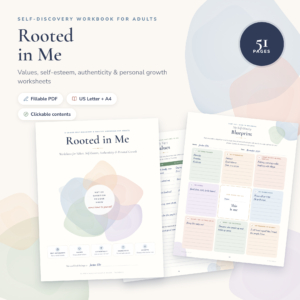
Rooted in Me Self-Discovery Workbook
Price: $4.99 | Best for: adults sorting out values and boundaries
A self-discovery workbook for adults with self-identity, values, self-esteem and boundaries worksheets, printable and fillable PDF in US Letter and A4. A gentle companion when you want to explore what you stand for.
Comparing the Options
| Product | Format | Price | Best for | Link |
|---|---|---|---|---|
| Steady Ground ACT Therapy Worksheets Bundle | 320 fillable pages, 10 workbooks and 48 metaphor cards, PDF | $19.99 | The full ACT set | View |
| Inner Compass Self-Discovery Workbook | 105-page fillable PDF with 72 values cards | $3.68 | Values work | View |
| Rooted in Me Self-Discovery Workbook | Fillable and printable PDF for adults | $4.99 | Values and boundaries | View |
The price gap is big, so think about use. $19.99 for 320 pages is about six cents a page. If you only need the values step, the $3.68 Inner Compass workbook is plenty to start.
Common Mistakes With ACT Therapy Worksheets
Treating acceptance as giving up. It is not resignation. You accept the feeling, not the situation. You can accept anxiety and still work to change your job.
Using defusion to shut feelings down. If you say “I’m having the thought that…” just to make a feeling go away, you are back to fighting it. The aim is to hold it more loosely, not to win.
Skipping values. People like the mindfulness bits and drift past values. But values are what give the other skills a point.
Setting huge actions. A commitment to “get fit” falls apart by Thursday. A commitment to a ten-minute walk after dinner can last.
Expecting calm. ACT does not promise fewer difficult feelings. It aims at a fuller life with them. Calm often comes as a side effect, not the goal.
Frequently Asked Questions
What are ACT therapy worksheets?
They are printable exercises based on Acceptance and Commitment Therapy. They cover skills such as accepting feelings, stepping back from thoughts, staying present, clarifying values and taking committed action. You complete them privately or with a therapist.
Can I use ACT worksheets without a therapist?
Many people use them on their own as self-help. Still, a therapist can tailor the work and offer support, especially if you are dealing with trauma, long-term low mood or severe anxiety. Think of worksheets as a tool, not treatment.
How is ACT different from CBT?
CBT often focuses on testing and changing unhelpful thoughts. ACT focuses on changing your relationship with thoughts, letting them be there while you act on your values. The two share ground, and some therapists blend them.
How long should I spend on each worksheet?
Ten to twenty minutes is usual. Short, regular sessions beat long, rare ones. Two or three per week is a steady pace for most people.
Are the Steady Ground worksheets fillable?
Yes. The Taskdale listing describes 320 fillable pages as a US Letter and A4 PDF, so you can type into them or print them and write by hand.
Take One Small Step
Start with the struggle log tonight. Ten minutes, one feeling, honest notes. Then, if you want a complete toolkit, the Steady Ground ACT Therapy Worksheets Bundle offers 320 pages and 48 metaphor cards for $19.99. ACT therapy worksheets will not remove hard days. But they can teach you to take the next step on one anyway.