Entrepreneur habits that keep ventures alive are rarely exciting. A Friday hour with the numbers. A message to a past client every Tuesday. A short note on what got done today. Big ideas start businesses. Small, boring repeats keep them breathing through the slow months, the late invoices and the week when nothing seems to work.
This guide is for solo founders, freelancers, side hustlers and small business owners who are juggling everything themselves. You will get seven habits that protect cash, customers and your own energy, a sample week that fits them together, the mistakes that quietly sink small ventures, and a few spreadsheets and planners that make the habits easier to keep.
No promises of overnight growth here. Just the steady stuff that gives a venture time to work.
Quick picks: tools that support these habits
| Product | Best for | Price | Link |
|---|---|---|---|
| ProfitPetal Small Business Bookkeeping Spreadsheet | A weekly money check in Excel | $26.00 | View |
| Dry Spell Cash Kit Freelancer Guide | Closing a cash gap between projects | $5.99 | View |
| HabitPulse Habit Tracker Spreadsheet | Tracking daily and weekly business actions | $1.87 | View |
| Twelvefold 2027 Printable Calendar & Monthly Planner | Monthly goals, bills and reviews on paper | $2.99 | View |
Why steady habits beat bursts of effort
Most small ventures do not end in one dramatic crash. They fade. The founder gets busy with client work and stops marketing. Invoices slip. The books fall three months behind. By the time the bank balance looks scary, the problem started back in spring.
Bursts of effort feel productive. A whole weekend rebuilding the website. A frantic week of cold emails after a bad month. But bursts are followed by crashes, and the crash is when things slide. A habit is smaller and duller, and it keeps going on the weeks you feel flat. That is exactly why it works.
Think of a bakery owner who spends 15 minutes every evening logging sales and checking tomorrow’s orders. Nothing about that is clever. Yet she spots the slow Tuesday trend in week three, not month six, and she has time to try a Tuesday special before it hurts.
Habit 1: a Friday money hour
Pick one hour a week, the same hour, and look at your money. Friday afternoon works for many people because the week is done and the numbers are fresh. Put it in your calendar like a client meeting. Do not cancel it for client work.
What to do in that hour
- Log every sale and expense from the week. Receipts, bank lines, platform payouts.
- Check who owes you. List unpaid invoices and how many days late each one is.
- Look at profit, not just sales. A busy week can still lose money if costs crept up.
- Move tax money aside. Put a set share of this week’s income into a separate account, so April does not ambush you.
- Write one sentence about what the numbers say. “Sales up, but packaging costs doubled” is enough.
That last line is the habit’s secret. After twelve Fridays, you have a running story of your business in your own words.
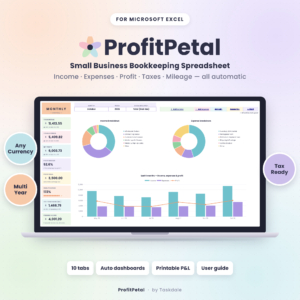
ProfitPetal Bookkeeping Spreadsheet
Price: $26.00 | Best for: freelancers, makers and service businesses
An Excel bookkeeping spreadsheet where you type the date, category and amount and it builds monthly and annual dashboards, profit goals, category budgets with on-track alerts, a tax planner that shows how much to set aside, a mileage log and a print-ready Profit and Loss statement. No formulas to write. Set up your categories in the first session, then log one month of past transactions to see the dashboards fill.
If you would rather build your own system, our guide to the self-employed bookkeeping spreadsheet explains which columns and categories to start with.
Habit 2: know your cash gap, and chase invoices on a schedule
Plenty of profitable small businesses still run out of cash. The work is done, the invoice is sent, but the money arrives 45 days later while rent is due next week. The habit here is knowing your gap number before it bites.
Work out your gap number
Add up what you must pay this month: rent, software, loan payments, your own minimum pay. Subtract what you are sure will arrive. The difference is your gap. A freelance designer might find she needs 3,200 this month, has 2,000 confirmed, and so has a 1,200 gap. Now the question is concrete: how do I bring in 1,200 in the next three weeks?
Chase on a calendar, not on a mood
Set a follow-up rhythm for every invoice and stick to it. A polite reminder on the due date. Another at 7 days late. A phone call at 14 days. Writing these dates down when you send the invoice takes the awkwardness out, because you are following a routine rather than deciding whether to be pushy.

Dry Spell Cash Kit
Price: $5.99 | Best for: freelancers between big projects
Nine working files built around getting money in during slow spells: an 83-page guide with built-in worksheets, a weekend offer plan, a 7-day mini-course, 150 AI prompts, 35 client scripts, a 108-point listing checklist for Fiverr or Upwork, and an Excel tracker that works out your cash gap. It also covers deposits, shorter payment terms and a follow-up schedule for late invoices. Start by filling in the gap number worksheet.
For a broader look at planning money in and out over a quarter, see our guide to the cash flow budget for small businesses and freelancers.
Habit 3: talk to a customer every week
It is easy to spend a whole month building and never speak to the people who pay you. Then you launch something nobody asked for. A weekly customer conversation is cheap insurance against that.
It does not need to be formal. A ten-minute call with a regular client. A short message to a past buyer asking how they used what they bought. Five minutes chatting with a shopper at your market stall about why they picked one item over another. Write down one thing you learned each time.
A dog walker who asks each new client “what nearly stopped you booking?” will hear the same answer three times in a month. Maybe it is the lack of a trial walk. Now she knows exactly what to add. That kind of insight rarely comes from staring at a spreadsheet.
Questions that open people up
- What were you trying to sort out when you found us?
- What almost made you choose someone else?
- What is still annoying about this, even now?
- If you could change one thing, what would it be?
Habit 4: track a few daily actions that lead to sales
Revenue is a result. You cannot do revenue on a Tuesday morning. What you can do is the action that leads to it: send three pitches, post one useful piece of content, follow up two warm leads, add one product listing. These are the levers you control.
Pick three to five of these actions and track them daily or weekly. Not as a guilt list. As a simple record that shows, over a month, whether the slow sales line up with a slow stretch of outreach. Very often they do, and seeing it in green and empty cells is more persuasive than any pep talk.
Set realistic targets per week
Do not demand outreach seven days a week. Set a target like “pitch on 4 days” or “post content 3 times”. Rest days should not count as failures, or you will abandon the tracker by week two.

HabitPulse Habit Tracker Spreadsheet
Price: $1.87 | Best for: founders tracking daily business actions
A full-year habit tracker for Excel and Google Sheets with up to 30 daily habits and 15 weekly habits on twelve monthly tabs. Each habit gets a days-per-week target, so a 4-day habit has a fair monthly goal, and the sheet builds streaks, charts, a top 10 list and a yearly dashboard with a heatmap. Comes in Dark and Light editions. Enter your three business actions first, then add personal habits if you like.
Our walk-through of the habit tracker spreadsheet covers how to pick habits that are small enough to keep.
Habit 5: one protected block for the work that grows the business
Client work, emails and admin will happily fill every hour. The work that grows the venture, a new offer, a better website page, a product you can sell twice, never feels urgent. So it never happens unless you guard time for it.
Block 60 to 90 minutes, most days, at the same time. Phone in another room. Email closed. Work on one thing only. A wedding photographer might spend that block building a second-shooter package. A bookkeeper might draft a small course for new business owners. Over three months, those blocks add up to roughly 60 to 90 hours of building. That is a real asset.
Protect it like a client booking. If someone asks for a call at 9 a.m. and 9 a.m. is your block, offer 11 instead. Most people will not mind.
Habit 6: a monthly review and a quarterly keep-or-kill
Weekly habits handle the day-to-day. Once a month, step back. Once a quarter, step back further.
The monthly review, 45 minutes
- Profit this month versus last month, and why
- Bills and renewals due next month
- Top three goals for next month, written down
- One thing that went well, one thing to fix
The quarterly keep-or-kill
Every three months, list everything you are doing: each product, service, channel and subscription. For each one, ask whether it earns its place. Keep, change or kill. A craft seller might find that her market stall brings in steady money while a paid ad campaign has quietly cost her more than it returned. Killing the ads frees both cash and attention.
This is hard. Founders love their ideas. But a venture with ten half-tended projects is more fragile than one with three healthy ones.

Twelvefold 2027 Printable Calendar
Price: $2.99 | Best for: founders who plan months on paper
A 32-page dated 2027 calendar and monthly planner with a calendar grid for every month plus a plan page holding top 3 goals, about 20 to-dos, a bills and payments table, notes and wins, and a 6-habit tracker. There is also a goals page by life area and quarter, and a 2028 overview. Print on Letter or A4 in Sunday or Monday start, or use it on a tablet. Fill in your bills table for January first.
Habit 7: rest on purpose
Running a venture alone can swallow evenings, weekends and holidays. For a while that feels like commitment. Over a year, it often turns into tired decisions, short tempers with clients and a creeping wish to quit. A venture needs its founder to still want to show up in year three.
Rest as a habit means fixed stopping points. A shutdown time most weekdays. One full day off each week. A real break of at least a few days each quarter, planned in advance so clients know. A café owner who closes on Mondays is not lazy. She is making sure Tuesday’s version of her is worth having behind the counter.
Write your rest into the same planner as your work. If it is not on the page, it will be the first thing to go.
Putting it together: a sample week
Here is how the habits fit into one ordinary week for a solo service business.
- Monday: 8:30 to 10:00 build block. Client work after. Log outreach in the tracker.
- Tuesday: Build block. Ten-minute call with one customer. Note one thing learned.
- Wednesday: Build block. Send invoice reminders due this week.
- Thursday: Build block. Client work. Post one piece of content.
- Friday: Client work until 2. Money hour from 3 to 4. Shut down at 5.
- Saturday: Off, or light admin only if you choose.
- Sunday: Off. Ten minutes in the evening to glance at next week.
On the last Friday of the month, the money hour stretches into the monthly review. Every third month, add the keep-or-kill list.
Mistakes that quietly sink small ventures
- Skipping the money hour when busy. Busy months are exactly when costs and late invoices pile up unseen.
- Tracking too many habits. Fifteen tracked actions becomes a chore. Three to five is plenty.
- Mixing business and personal money. It makes every review harder. Open a separate account.
- Never saying no. Every low-paying job you accept takes a slot from better work.
- Running on adrenaline. It works for a launch week. It does not work for a year.
Frequently asked questions
What daily habits do successful entrepreneurs have?
Common ones are a protected block for growth work, a few tracked sales actions such as pitches or follow-ups, and a quick end-of-day note on what got done. The exact habits matter less than doing them consistently.
How often should a small business owner review finances?
Weekly for a quick check of income, expenses and unpaid invoices, and monthly for a deeper look at profit and the month ahead.
How do I keep my business going during a slow month?
Work out your cash gap, chase every unpaid invoice, contact past clients first and offer a small, quick service you can deliver fast. Cut costs that are not earning their place.
How many habits should I track at once?
Three to five business habits is plenty. Add more only once the first ones feel automatic.
Is rest really a business habit?
Yes. Fixed stopping points and planned breaks protect your judgment and your energy, which the business depends on for years, not weeks.
Your next step
Open your calendar right now and book a one-hour money check for this Friday afternoon, repeating every week. Then do it, even if the numbers are messy. If you want a spreadsheet that turns that hour into clear dashboards and a tax set-aside figure, start with the ProfitPetal Small Business Bookkeeping Spreadsheet.