A budget binder looks a bit old-fashioned. Pages, dividers, a pen on a string. And yet there is a reason it keeps coming back. When your money sits in one physical place, you cannot lose track of it behind a login screen. You open the cover and there it is: what came in, what is owed, what is left.
This guide shows what goes inside a budget binder, how to set one up in an afternoon, and four printable binders from Taskdale if you would rather not design the pages yourself.
Quick picks
| Product | Best for | Price | Link |
|---|---|---|---|
| Petal & Penny Budget Binder | A simple first binder at the lowest price | $1.49 | View |
| Sorbet Budget Binder | A bundle with savings challenges, debt payoff and bill trackers | $1.79 | View |
| Calm Money Budget Binder | Bill tracking, debt snowball and savings in a fillable PDF | $3.49 | View |
| Moneybloom 6-Month Budget Binder | A bigger binder with cash envelopes and sinking funds | $8.99 | View |
What Is a Budget Binder and Who Is It For?
A budget binder is a folder, usually a three-ring one, that holds all your money pages. Income, bills, debt, savings goals, and maybe a pocket for receipts or cash envelopes. Think of it as a home base for your finances.
It suits people who think better on paper. It also suits couples who want to sit at the table and see the same page, and anyone who has tried an app, felt nothing, and quit. If you have ever said “I do not know where it all goes,” a budget binder gives that sentence an answer.
It is less useful if you hate printing or never sit at a desk. In that case a digital planner might fit better. But plenty of people like the physical act, and that matters, because the best system is the one you actually touch.
What to Put in a Budget Binder: The Core Pages
You can keep it small. Six or seven sections cover most households. Here is the usual set, in the order I would arrange them.
1. A monthly budget page
One sheet that lists your income at the top and your planned spending below. It is the page you will fill in most often. Do it at the start of the month, or at the start of each pay period if you are paid more than once.
2. A bill tracker
A list of every bill with the amount, the due date and a box to tick when paid. Late fees add up quietly. A tick box is a surprisingly good cure.
3. A debt payoff tracker
List each balance, the minimum payment and the date you want it gone. Many people use the debt snowball method here: clear the smallest balance first, then roll that payment into the next one. Seeing a balance shrink on paper is oddly satisfying.
4. A savings tracker
Your goals, how much you want, and how much is in so far. An emergency fund, a holiday, a new laptop. Give each one a name and a number.
5. Sinking funds
These are small pots for bills you can see coming, like car insurance or birthdays. Instead of a shock, you set aside a bit each pay day.
6. Cash envelopes
If you spend a category in cash, say groceries or eating out, a pocket for the envelope keeps it honest. When the envelope is empty, the category is done for the month.
7. A pocket for receipts and notes
Not glamorous. Still handy when you need to find a warranty or check a charge.
How to Set Up Your Budget Binder in One Afternoon
Block out about two hours. Make tea. Here is the flow.
Start by gathering the facts. Pull your last two or three bank statements, your pay slips, and every bill you can find. Do not guess. A guess today becomes a surprise next month.
Next, print your pages and punch them. If you are using a fillable PDF, type your income and bills into the file first, then print. That way your handwriting only has to cover the daily bits. Add dividers so you can flip straight to a section.
Then fill in the monthly budget. Income at the top. Fixed bills first, like rent and insurance. Then food, transport, and the fun money. If the total is higher than your income, trim now, not later.
After that, set up the debt and savings pages. Even if you can only add $10 a month, write the number. A small number written down beats a big number imagined.
Finally, pick a budget meeting. Fifteen minutes, same time each week. Friday after work, Sunday morning, whenever you are least rushed. Open the budget binder, tick bills, update balances, close it. That is the whole trick.
Pick the Right Budget Binder Size and Format
Before you print anything, decide on the page size. Letter and A4 are the common ones, and Petal & Penny, Sorbet and Moneybloom all come in those. Sorbet also comes in A5, which is smaller and fits compact binders you can carry in a bag.
Some binders are fillable PDFs. That means you can type into them on your computer before printing, which is neat if your handwriting is rough or if you want numbers to look tidy. Calm Money and Sorbet are listed as fillable. Others are plain printables you fill in by hand.
Also think about how long the binder lasts. Moneybloom is a six-month binder and is undated, so you can start whenever you like. A shorter binder is lighter and less daunting. When it is full, you print a fresh set.
A Simple Example: One Month in the Budget Binder
Numbers make this real, so here is a made-up month. Say $2,400 comes in. Rent takes $900, utilities and phone $220, groceries $380, transport $150, and a minimum card payment of $60. That is $1,710 so far, which leaves $690.
Now you give the rest a job. $150 goes to an emergency fund. $100 goes to the card on top of the minimum, because that is your debt snowball target. $60 goes into a car insurance sinking fund. $80 is for eating out and fun, in a cash envelope. That is $390, and $300 remains.
What do you do with the last $300? Probably more of the same. Maybe $150 to the card and $150 to savings. The point is that every dollar ends up written on a page. Nothing is left floating, waiting to be spent on something you will not remember.
At the end of the month you compare the plan to what happened. Maybe groceries hit $420 instead of $380. Fine. Next month you plan $420, or you trim somewhere else. Your budget binder becomes a record of what your life really costs, and that is more useful than any guess.
Sharing a Budget Binder With a Partner
Couples often find a budget binder easier than an app, because there is one place to look. Sit down together once a month. Both people bring their statements. Agree on the fixed bills first, then decide how much each of you gets as personal spending money, no questions asked.
That last part saves arguments. When each person has a guilt-free amount, small purchases stop being a debate. The binder just shows what was agreed.
Our Budget Binder Picks From Taskdale
Here are four printable options. The details below come from each product listing.
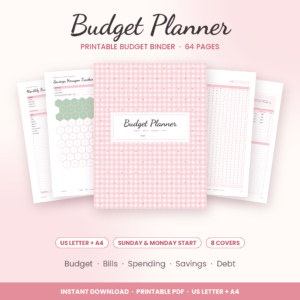
Petal & Penny Budget Binder
Price: $1.49 | Best for: A simple first binder at the lowest price
A printable budget planner with a bill tracker, savings challenges and a debt payoff tracker, as a US Letter and A4 PDF. It is a plain, low-cost way to start a binder.
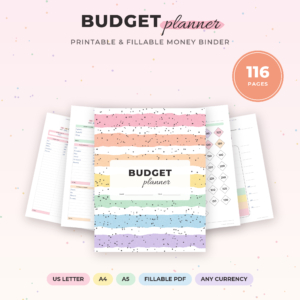
Sorbet Budget Binder
Price: $1.79 | Best for: A bundle with savings challenges, debt payoff and bill trackers
A printable budget planner bundle with savings challenges, debt payoff and bill trackers. It is a fillable PDF in US Letter, A4 and A5, so it also fits smaller binders.
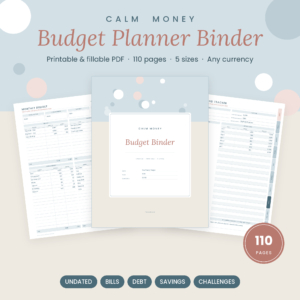
Calm Money Budget Binder
Price: $3.49 | Best for: Bill tracking, debt snowball and savings in a fillable PDF
A printable budget planner binder as a fillable PDF, with a bill tracker, debt snowball and savings tracker. Pick it if you want to type into the pages before you print.
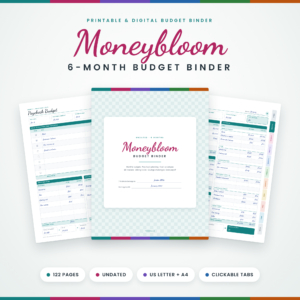
Moneybloom 6-Month Budget Binder
Price: $8.99 | Best for: A bigger binder with cash envelopes and sinking funds
An undated, printable six-month budget planner with paycheck budget, bill tracker, cash envelopes, sinking funds and savings challenges. It comes as a US Letter and A4 PDF.
Compare the Four Budget Binder Options
| Product | Format | Price | Best for | Link |
|---|---|---|---|---|
| Petal & Penny Budget Binder | Printable PDF, US Letter and A4 | $1.49 | A simple first binder at the lowest price | View |
| Sorbet Budget Binder | Fillable PDF, US Letter, A4, A5 | $1.79 | A bundle with savings challenges, debt payoff and bill trackers | View |
| Calm Money Budget Binder | Printable and fillable PDF | $3.49 | Bill tracking, debt snowball and savings in a fillable PDF | View |
| Moneybloom 6-Month Budget Binder | Undated printable PDF, US Letter and A4 | $8.99 | A bigger binder with cash envelopes and sinking funds | View |
Budget Binder Mistakes to Avoid
People tend to trip over the same few things. Here is how to sidestep them.
Making it too fancy. Washi tape and stickers are fun, but if setting up takes four hours, you will not update it. Function first, decoration second.
Printing everything at once. You do not need fifty pages. Print the core sections and a month or two of budget sheets. Add more as you need it.
Skipping the weekly check. A budget binder that you only open once a month will be a month out of date. Five minutes a week keeps it alive.
Ignoring irregular costs. Car repairs, school fees, gifts. If they are not in your budget, they will wreck it. That is what sinking funds are for.
Being too hard on yourself. You will overspend sometimes. Write it down anyway, adjust next month, and keep going. A binder full of honest numbers is worth more than a perfect one.
Frequently Asked Questions
What do you put in a budget binder?
Most budget binders hold a monthly budget page, a bill tracker, a debt payoff tracker, a savings tracker, sinking funds and a pocket for receipts. If you use cash, add envelopes. Start small with the core pages and add sections only when you need them.
How do I start a budget binder?
Gather your bank statements, pay slips and bills, then print your pages and fill in your income and fixed bills first. Add debt and savings pages, and pick a regular weekly time to update it. Setting it up usually takes an afternoon.
What size should a budget binder be?
Letter or A4 is the most common and gives you room to write. A5 is smaller and easier to carry. Sorbet comes in Letter, A4 and A5, while Petal & Penny and Moneybloom come in Letter and A4. Check the Calm Money listing for its sizes. Pick what fits the binder you own.
Is a budget binder better than an app?
It depends on you. A budget binder suits people who think better on paper and like seeing everything in one place. An app suits those who want automatic transaction imports. Many people try a binder first because it has no subscription and no login.
How often should I update my budget binder?
Set aside about fifteen minutes each week to tick off bills and update balances. Then do a longer review at the start of each month or pay period to set new numbers. Small, regular check-ins keep it accurate.
Your Next Step
So, here is the plain advice. Print the core pages, fill in your income and bills, and book your first weekly check-in before you close this tab. If you want pages ready made, Sorbet at $1.79 is an easy place to begin, and Moneybloom is there if you want cash envelopes and sinking funds too. Your future self, standing in front of an unexpected bill, will be glad you did.