Pick any big decision you are stuck on. A job offer, a move, a friendship that has gone sour. Chances are the real trouble is not the facts. It is that you have not named what matters most to you. A core values list fixes that. It hands you the words, lets you cut the list down, and leaves you with five anchors you can hold a decision against.
Below you will find a core values list of 72 values, a simple method to choose your top five, and printable options from Taskdale if you want physical cards to sort.
Note: this is general self-help information, not professional advice.
Quick picks
| Product | Best for | Price | Link |
|---|---|---|---|
| Inner Compass Self-Discovery Workbook | 72 core values cards plus 105 pages | $3.68 | View |
| Inner Compass Self-Identity Workbook | 72 core values cards in a shorter 79-page book | $3.59 | View |
| Becoming Me Self-Identity Workbook | Core values with strengths and confidence | $3.99 | View |
What Is a Core Values List, and Why Bother?
Core values are the handful of things you care about enough that you would pay a price for them. Honesty, say. Or family, or freedom, or learning. Everyone has them, but most people have never put words to them.
Here is why that matters. When you feel pulled in two directions, you are usually caught between two values. You want security and adventure at once. You want to be kind and also to be honest. Naming the values turns a vague knot in your stomach into a clear choice, and clear choices are easier to make.
A written core values list also protects you from borrowed goals. Plenty of people chase promotions or houses because everyone around them does, not because they want them. When you sort values on your own, away from the crowd, the borrowed ones often fall away fast.
And there is a calmer benefit. People who know their values tend to stew less over small slights. They can say, “That does not fit what I care about,” and let it go.
A Core Values List of 72 to Choose From
Read through the groups below and mark any word that makes you feel something, whether warm, proud, or a little defensive. Do not think too hard. This is my own list, written for this article, so feel free to add words that are missing.
Character
Honesty, integrity, courage, humility, patience, discipline, kindness, fairness, loyalty, gratitude, responsibility, self-respect.
Relationships
Family, friendship, love, trust, belonging, community, respect, generosity, compassion, forgiveness, connection, service.
Growth and mind
Learning, curiosity, wisdom, creativity, growth, mastery, focus, play, knowledge, reflection, imagination, self-awareness.
Life and lifestyle
Freedom, adventure, health, balance, simplicity, comfort, security, stability, peace, fun, independence, nature.
Achievement and impact
Success, excellence, leadership, ambition, recognition, wealth, impact, purpose, contribution, legacy, teamwork, hard work.
Spirit and meaning
Faith, hope, joy, authenticity, beauty, spirituality, tradition, justice, optimism, wonder, truth, acceptance.
That is 72 words. If your favorite did not make it, write it in the margin. A core values list is only useful if it is yours.
How to Choose Your Top Five Core Values
Here is the method I like best, and it takes about thirty minutes. Do it once with a pen, then leave it for a day.
Step one: circle freely
Go through the list and circle everything that appeals. Aim for twenty to thirty words. Do not stop to debate yet. Speed helps here, since your first reaction tells you more than your tidy reasoning.
Step two: cut to ten
Now group words that mean nearly the same thing. “Peace” and “balance” may sit together. “Honesty” and “integrity” may too. Keep the one that feels more like you. You should land near ten.
Step three: ask the hard question
Take two values at a time and ask, “If I could only have one, which would I keep?” Yes, it is uncomfortable. That discomfort is the sorting process working. Keep the winner, move on to the next pair, and carry on until five remain.
Step four: check them against real life
Look at your last month. Where did your time and money go? If you picked “health” but have not exercised in weeks, that does not make the value fake. It means you have a gap to look at. If a value does not show up anywhere in your actual choices, ask whether it is yours or someone else’s.
Step five: write one sentence for each
Next to each value, write what it means in practice. “Family” might become “I call my mother every Sunday and show up for birthdays.” Concrete beats abstract every time.
Using Your Core Values List in Daily Choices
A list in a drawer does nothing. Put it where you will see it: on the fridge, inside a notebook cover, as a phone note. Then use it in three ways.
First, as a filter for big decisions. Suppose you are weighing a job that pays more but means long hours. Hold it against your five. If “family” and “health” are on the list, you can see the cost on the page rather than in a fog of worry.
Second, as a weekly check. Every Sunday, spend five minutes asking which value you served best this week and which you ignored. No guilt. Just notice.
Third, as a way to say no. Politely refusing a request is far easier when you can tell yourself, “This takes time from something I care about.” It sounds small, but it changes how bad the refusal feels.
One more thing. Your values will shift. A new baby, a health scare, a career change can reorder the list. Revisit it once a year, or after any big event. That is not flip-flopping. It is paying attention.
Three Short Examples of Values at Work
Abstract advice only goes so far, so here are three made-up scenes to show how a short list gets used.
Maya has “creativity,” “independence,” “family,” “health” and “honesty” on her list. A steady office job comes up. The pay is good, but the rules are rigid and the hours run late. She does not need a spreadsheet. Two of her five values are in trouble at once, and she can see it. She turns the job down and takes freelance work instead, knowing the trade-off.
Tom picks “success,” “security,” “loyalty,” “discipline” and “learning.” His friends tell him to quit a stressful job. But when he checks his list, security and loyalty are both tied to staying put for now, and learning is still happening there. So he stays, and asks for a lighter workload instead of leaving. The list did not push him toward the dramatic option. It helped him pick the right one.
Priya notices that “friendship” is on her list, yet she has not called a close friend in months. No drama, only drift. She sends a message that evening. Small, but real.
Notice what each person did. They did not use values to feel noble. They used them to see where their time was going and to make one change. That is the whole trick, and a core values list makes it possible.
Core Values Cards and Workbooks on Taskdale
Sorting words on a screen works, but many people think better with cards in hand. Moving a card from one pile to another makes the choice feel real. These three printable products from Taskdale are built around that idea.

Inner Compass Self-Discovery Workbook
Price: $3.68 | Best for: sorting values and exploring who you are
A 105-page fillable and printable Who Am I journal that includes 72 core values cards, plus self-esteem and identity worksheets, for teens and adults. US Letter and A4 PDF. The cards fit the sorting method above, and the extra pages give you room to write your one-sentence meanings.
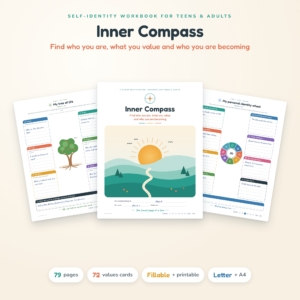
Inner Compass Self-Identity Workbook
Price: $3.59 | Best for: a lighter, shorter option with the same cards
A 79-page printable and fillable Who Am I self-discovery journal with 72 core values cards, for teens and adults. US Letter and A4 PDF. A neat choice if you want the cards without a bigger book.
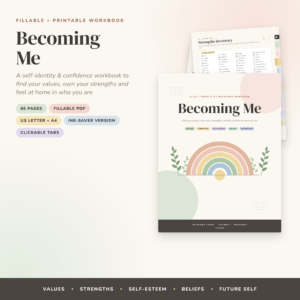
Becoming Me Self-Identity Workbook
Price: $3.99 | Best for: values plus strengths and confidence
A 66-page fillable and printable self-discovery workbook for self-esteem, core values, strengths and confidence, listed as therapy worksheets. US Letter and A4 PDF. Pick it if you want your values work to sit alongside confidence building.
Comparing the Options
| Product | Format | Price | Best for | Link |
|---|---|---|---|---|
| Inner Compass Self-Discovery Workbook | 105-page fillable PDF with 72 core values cards | $3.68 | Values plus deeper journaling | View |
| Inner Compass Self-Identity Workbook | 79-page fillable PDF with 72 core values cards | $3.59 | A compact start | View |
| Becoming Me Self-Identity Workbook | 66-page fillable PDF | $3.99 | Values with confidence work | View |
For a pure core values list exercise with cards, either Inner Compass edition does the job. The longer one simply gives you more writing space.
If you share your life with a partner, try the exercise side by side, then compare lists over dinner. Do not expect matching answers. Matching is not the goal. The goal is to find out what the other person is protecting, which explains a lot of old arguments. Many couples find that they fight about different tools while defending the same value underneath. That discovery alone can soften a long-running disagreement, and it costs nothing but an hour.
Keep a copy of your top five somewhere you will meet it by accident. A sticky note inside the bathroom cabinet works better than you would think. Seeing the words when you are half awake, before the day has told you what to care about, nudges your choices in small ways. After a month, check which value you have been leaning on most. The answer is often a surprise, and a useful one.
Mistakes to Avoid When You Pick Core Values
Choosing what sounds good. “Wealth” may feel greedy to say aloud, so people swap in “security.” If you truly want money, say so. Honest values are more useful than flattering ones.
Picking too many. Fifteen values is a wish list, not a compass. Five is hard and that is the point.
Copying someone else’s list. A coach, a parent, or a famous author may hold values that do not fit you. Borrow the method, not the answers.
Treating it as a one-time task. A list you never look at again is a nice evening, nothing more. Put it to work.
Using values as a weapon. Your list is for you. Wielding it against others (“You clearly don’t value honesty”) tends to end badly.
Frequently Asked Questions
What is a core values list?
It is a set of words naming the principles that matter most to you, such as honesty, family or freedom. People start with a long list of options, then narrow it to a small handful to guide decisions.
How many core values should I have?
Most people do well with three to five. Fewer than that can feel thin. More than seven becomes hard to remember or apply. Five is a good target because each value then gets real attention.
Can my core values change over time?
Yes. Big life events like a new child, illness or career change often reorder them. Revisit your list yearly and after any major event. A shift is a sign you are paying attention, not that you were wrong before.
What if two of my values conflict?
That is normal. Freedom and security often pull against each other. Use the conflict as information: ask which one you protect when you must choose. Your choices over time show which value ranks higher.
Are printable values cards better than a list?
Cards let you physically sort and re-sort, which many people find clearer than circling words. A plain list works too. Use whichever helps you make firm choices. The Inner Compass workbooks include 72 values cards.
Your Next Step
Set a timer for thirty minutes this weekend, go through the 72 words above, and cut your way down to five. Then write your one-sentence meanings. If you would like cards to sort, the Inner Compass Self-Discovery Workbook comes with 72 core values cards for $3.68. Your core values list will not change your life overnight. But it will make Monday’s decisions a bit easier.