Picture a parent with three kids, a full time job and a calendar that looks like a game of Tetris. One of the best things that parent can do for the family is also the cheapest: one hour, one child, no phones. No big outing. Just a walk to the shop for ice cream and a long, wandering chat. Dates with kids don’t need a budget or a plan. They need you, a little time and a child who knows the time is theirs. Below you’ll find a big batch of ideas, a simple way to schedule them and a memory book to keep the stories.
Quick picks
| Product | Best for | Price | Link |
|---|---|---|---|
| Date Days Together: 100 Dates With Kids Memory Book | Parents planning one-on-one time | $9.97 | View |
| Little Lighthouse Self-Regulation Book for Kids 3-7 | Kids ages 3 to 7 | $9.99 | View |
Why one-on-one dates with kids matter
Family time is lovely, but it’s loud. In a group of four, the chatty child gets the talking and the quiet one gets the leftovers. A one-on-one date flips that. For an hour, the quiet child is the main character.
You’ll hear things you never hear at dinner. A seven year old might mention a worry about a friend. A twelve year old might bring up something awkward in the car because they don’t have to look at you. Kids open up side by side, doing something, far more than face to face across a table.
And there’s the plain, happy fact that kids remember attention. Not gifts, not trips. They remember the afternoon you laughed at the same silly thing. That is a very cheap thing to give, and it pays back for years.
How to set up dates with kids that actually happen
Good intentions die on a busy calendar. Here’s how to stop that.
Put it on the calendar like a meeting
If it isn’t written down, it won’t happen. Pick a regular slot. First Saturday of the month. Tuesday after school. Whatever fits. Kids love a fixed date they can count down to.
Let the child choose (sometimes)
Alternate between your picks and theirs. Their choices might be odd. A trip to the hardware store, a pancake breakfast, an hour of watching them play a video game. Go with it. The point is that it’s theirs.
Keep the phone away
This is the hard one. Put it in the glove box or leave it at home. Kids can tell when you’re half there, and they stop trying.
Keep it short and easy
An hour is plenty. Don’t turn it into a project. If a date takes three hours to plan and costs a fortune, you won’t do it twice. Simple repeats.
Rotate fairly
With more than one child, track turns. A simple chart on the fridge stops “but she got two” before it starts.
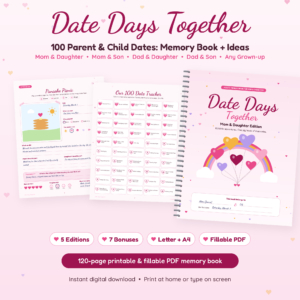
Date Days Together: 100 Dates With Kids Memory Book
Price: $9.97 | Best for: Parents planning one-on-one time
A memory book built around 100 dates with kids, delivered as a printable and fillable PDF. You plan the outing, then fill in the page afterward so the day is written down while it is still fresh.
Free ideas at home or nearby
You don’t need money. Here are ideas that cost nothing or close to it.
Build a blanket fort and read inside it with a flashlight. Cook a recipe together, even a simple one, and let them do the messy bits. Go on a nature walk and collect five leaves, three stones and one weird stick. Have a backyard picnic, or a living room picnic if it’s raining. Do a “photo walk” where each of you takes ten pictures of things that look interesting. Play board games, but let the child pick and teach you the rules. Stargaze with a blanket and hot chocolate. Wash the car together and spray each other. Bake cookies for a neighbor. Draw each other’s portraits and then compare. Make a treasure hunt with clues you hide around the house.
Ride bikes to a park you don’t normally visit. Visit the library and each pick a book for the other. Watch the sunrise or sunset from a hill. Make paper airplanes and test whose goes farthest. Put on music and have a living room dance contest. Plant something, a pot of herbs or a bean in a cup, and check on it each week.
Low-cost ideas that feel special
Spending a few dollars can make an ordinary day feel like an event. Think small.
Take your child for ice cream, just the two of you, and let them order whatever they like. Try a new kind of food from a small local restaurant, and play “guess the ingredients.” Visit a farmers market and give your child five dollars to spend however they want. Go to a cheap matinee, or a second hand bookshop where you each find a treasure. Try mini golf, a bowling lane or the skating rink.
Take a trip to the pet store to look at the animals, with no promise to buy one. Go fruit picking if you have a farm nearby. Visit a museum on its free day. Take a bus ride to the end of the line and back, which sounds boring and is secretly great. Stop at a hardware store and let your child pick a small project to build together, like a birdhouse.
Date ideas by age
What works at four fails at fourteen. Adjust.
Ages 3 to 5: short and silly
Thirty to forty five minutes is enough. Play pretend, splash in puddles, go to the playground and let them lead. Little ones want your full attention and a bit of silliness. Don’t worry about the destination.
Ages 6 to 9: adventures and projects
This age likes missions. A scavenger hunt, a bike ride to somewhere new, a cooking project, a trip to a place they’ve heard about. Let them hold the map or the money. They love responsibility.
Ages 10 to 13: talk while doing
Tweens may groan at the word “date.” Call it a “hangout” or a “mission.” Pick something active or hands on, like a hike, a game, a food run. The conversation comes sideways, usually on the way home.
Teens: let them steer
Offer, don’t insist. A teen who says yes to a late night burger run is giving you a gift. Say thanks, listen more than you talk, and don’t turn it into a lecture.

Little Lighthouse Self-Regulation Book for Kids 3-7
Price: $9.99 | Best for: Kids ages 3 to 7
A 223-page self-regulation book written for kids 3 to 7. It suits parents and teachers of little ones who want one big resource for feelings and calming skills in place of a pile of loose pages.
What to talk about once you’re there
Some kids chat nonstop. Others go quiet the moment you ask “so, how was school?” Skip that question. It gets a one word answer every time. Try something odder. “What was the funniest thing you saw this week?” or “If you could change one rule at our house, which one?” Silly questions get real answers.
A few more that work: “What’s something you’re proud of that I don’t know about?” “Who did you sit with at lunch?” “What would you do with a free day and no rules?” Then comes the hard part. Listen. Don’t fix, don’t correct, don’t tell the story of your own childhood. Nod, ask one more question and let the silence sit for a moment. Kids fill it, usually with the truest thing they’ve said all week.
If the talk dries up, that’s fine. Walking side by side in quiet is also a date. You’re showing up, and your child can feel it.
Keep the memories: why a memory book helps
Here’s what happens without a record. You do a wonderful date. Three months later you can’t recall what you did, and neither can your child. The details wash out.
A memory book catches them. After each date, you and your child write down where you went, what you ate, the funny thing someone said. Maybe a drawing, maybe a ticket stub. It takes five minutes. The next time you open it, you’ll both be laughing.
For children, seeing the pages stack up is its own reward. They can flip back and see all the times they were the main character. Years from now, a teenager might not remember the ice cream trip, but they’ll read the page in their own handwriting and know they were loved.
The Date Days Together book is built for this. It’s a printable and fillable PDF organized around 100 dates with kids, so you can print the pages and fill them in as you go, or type into the PDF. Many parents prefer paper for the keepsake feeling. Either way, it gives you a ready place to put the stories.
Mistakes that spoil a good date
A few traps, and how to dodge them.
Planning too much. If you schedule every minute, there’s no room for the wandering chat where the good stuff happens.
Turning it into a reward or a punishment. “No date if you misbehave” ruins the point. Dates should be a given, not a prize.
Comparing. Don’t judge yours against pictures online. A walk to the bakery beats a fancy outing you stress over.
Letting it slip. Missing one date is fine. Missing six and never mentioning it tells a child they’re low priority. If you have to cancel, reschedule at once and say sorry.
Using the time to fix behavior. Save the “we need to talk about your grades” for another day. A date is a safe place.
Compare the options
If you want something to hold the memories, or a book to share on a quiet date, here are two Taskdale picks side by side.
| Product | Format | Price | Best for | Link |
|---|---|---|---|---|
| Date Days Together: 100 Dates With Kids Memory Book | Printable & fillable PDF | $9.97 | Parents planning one-on-one time | View |
| Little Lighthouse Self-Regulation Book for Kids 3-7 | 223-page book | $9.99 | Kids ages 3 to 7 | View |
Questions about dates with kids
How often should I plan dates with kids?
Once a month per child is a realistic start, and weekly is lovely if your schedule allows. Consistency beats frequency. A small, regular date that always happens means more to a child than a big one that gets canceled.
What if my child doesn’t want to go on a date?
Don’t force it. Offer choices, and make it clear it’s their pick. Some kids, especially tweens, prefer a casual vibe. Try calling it a hangout, or do something side by side. Keep inviting without pressure, and they usually come around.
How do I handle dates with several children?
Give each child their own slot and keep a simple turn chart. If one date a month per child feels like too much, alternate weeks. Siblings often like knowing their turn is coming. Also plan a few group family outings so nobody feels left out.
Do dates with kids need to cost money?
No. Many of the best ones are free: walks, picnics, forts, bike rides, baking. A few dollars for ice cream is a nice extra, not a requirement. What matters is your undivided attention, not the price tag.
What age is best to start?
Any age works. Toddlers enjoy a short walk or playground trip with your full attention. The habit gets stronger when you start early, but it is never too late. Even a teenager will often welcome a low key invitation.
Plan your first date this week
Pick one child, one hour and one easy idea. Put it on the calendar now, before the week fills up. Then afterward, write down three things you remember. If you’d like a ready place to keep those pages, the Date Days Together memory book is built around 100 dates with kids. And if one of your dates is a quiet reading afternoon with a little one, the Little Lighthouse book gives you something to share.