Ask someone who they are and watch what happens. Most people give a job title, a family role, maybe a hometown. Then they go quiet, because they know that is not really the answer. Good self discovery questions get under the labels. They ask what you care about, what you avoid, and what you keep saying yes to when you want to say no.
Below are 60 questions to work through at your own pace, plus advice on how to answer them honestly and four printable workbooks on Taskdale if you want a structured place to do it.
Note: this is general self-help information, not professional advice or a replacement for therapy.
Quick picks
| Product | Best for | Price | Link |
|---|---|---|---|
| Inner Compass Self-Identity Workbook | A short 79-page start with 72 core values cards | $3.59 | View |
| Inner Compass Self-Discovery Workbook | The longer 105-page edition | $3.68 | View |
| Becoming Me Self-Identity Workbook | Values, strengths and confidence | $3.99 | View |
| Rooted in Me Self-Discovery Workbook | Adults working on identity and boundaries | $4.99 | View |
Why Self Discovery Questions Beat Personality Quizzes
Quizzes hand you a result. You tick boxes, get a four-letter type, feel briefly understood, and forget it by Friday. Questions work the other way around. You do the thinking, and the answer belongs to you.
That matters because identity is not a fixed label. It shifts across years. The person who wrote “I want security” at twenty-five may write “I want freedom” at forty. Asking the questions again every so often is how you catch the change before it surprises you.
There is also a practical reason. Many big choices, such as a career move, a breakup, or a decision to go back to school, come down to one problem: you do not know what you want. A page of honest answers will not decide for you. But it clears away a lot of fog.
How to Answer Self Discovery Questions Honestly
Honesty is the hard part. Not because you want to lie, but because you have practiced the polite version for years.
Write the first answer, then the second
Your first answer is often the one you think you are supposed to give. Write it. Then ask, “And if nobody would ever read this?” The second answer is usually closer to the truth.
Keep each session short
Five questions in fifteen minutes beats sixty questions in one tired evening. Your mind needs gaps to keep making connections. Many people notice their best answers arrive in the shower the next morning.
Date your pages
Put the date at the top. In six months you will want to see how your answers moved. That comparison is half the value.
60 Self Discovery Questions to Start With
Work through them in any order. Skip any that feel flat, and linger on any that sting a little. The sting is usually a clue.
Your past (questions 1 to 10)
- What did you love doing at age ten?
- Which childhood memory still feels warm?
- What did your family praise you for?
- What did your family make you feel ashamed of?
- Who shaped you most, for good or bad?
- What rule did you learn early that you still follow?
- When did you first feel proud of yourself?
- What is the hardest thing you have lived through?
- What did that teach you?
- What would you tell your younger self?
Your values (questions 11 to 20)
- What matters more to you than money?
- What makes you angry on someone else’s behalf?
- Which three words would you want said at your funeral?
- What do you refuse to compromise on?
- Whom do you admire, and what exactly do you admire?
- What do you envy in others?
- When do you feel most like yourself?
- What would you do if you were not afraid of judgment?
- What does a good day look like?
- What does a good life look like?
Your strengths (questions 21 to 30)
- What do people ask you for help with?
- What comes easily to you that others find hard?
- What have you taught yourself?
- What do you lose track of time doing?
- What compliment do you brush off?
- Which hard moment did you handle better than you expected?
- What are you stubborn about, in a useful way?
- What do you notice that others miss?
- How do you help friends in a crisis?
- Which skill do you want to grow next?
Your relationships (questions 31 to 40)
- Who can you be fully honest with?
- Who drains you, and why?
- Where do you say yes when you mean no?
- What do you need from friends that you rarely ask for?
- How do you act when you feel unsafe?
- What pattern keeps repeating in your relationships?
- Who have you not forgiven?
- Whom do you need to apologize to?
- Do you feel lonely, and in what situations?
- What kind of friend are you?
Your fears and habits (questions 41 to 50)
- What are you avoiding right now?
- What is your loudest fear?
- What story do you tell about why you cannot change?
- What do you do when you feel stressed?
- Which habit would you quit tomorrow if you could?
- Which habit are you proud of?
- How do you talk to yourself after a mistake?
- What do you pretend not to care about?
- When did you last cry, and why?
- What would you do differently if failure were impossible?
Your future (questions 51 to 60)
- Where do you want to be in five years?
- What would you regret not trying?
- What is one small change you could make this month?
- What would you stop doing if you were allowed to?
- What do you want to be known for?
- What would a braver version of you do?
- Which of your values are you not yet living out?
- What are you grateful for today?
- What do you still want to learn?
- Who do you want to become?
One more tip for the list above. Pick the question that makes you want to skip ahead, and answer that one first. Resistance points at something that matters. Good self discovery questions are often uncomfortable for exactly that reason, and a minute of squirming is a fair price for a straight answer. Keep a pen in your hand and do not stop to reread until the timer rings.
Turning Your Answers Into Something Useful
Answers sitting in a notebook do very little. The next step is to read them back and look for repeats. Did the same word show up four times? Did the same person appear in your fear answers and your anger answers? Highlight those. Patterns are the real result.
Then, from your patterns, pick a short list of core values. Most people do best with five. That sounds simple, but it is hard to cut, because many values feel good. If you pick “freedom,” “family,” “honesty,” “growth” and “health,” you can test your week against them. Did Tuesday’s meeting fit your list? Did the argument on Saturday?
A values list also helps with small decisions. Offered a project that pays well but eats every weekend, you can hold it against “family” and “health” and see the cost at once. That is the daily use of knowing who you are.
Finally, choose one action. Not ten. One small thing that lines up with a value you are neglecting, with a date beside it. Self-knowledge that never turns into action tends to fade into a pleasant mood and nothing more.
Self Discovery Workbooks on Taskdale
Some people like a blank notebook. Others like pages laid out for them. If you are in the second group, these four printable workbooks give your self discovery questions a structure.
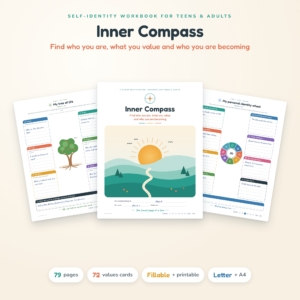
Inner Compass Self-Identity Workbook
Price: $3.59 | Best for: a first self-discovery workbook
A 79-page printable and fillable Who Am I self-discovery journal with 72 core values cards, for teens and adults. US Letter and A4 PDF. The values cards are handy for the five-values exercise above.

Inner Compass Self-Discovery Workbook
Price: $3.68 | Best for: going deeper with more pages
The longer edition: a 105-page fillable and printable Who Am I journal with 72 core values cards, plus self-esteem and identity worksheets, for teens and adults. US Letter and A4 PDF. Choose this one if you want extra room to work through the questions.
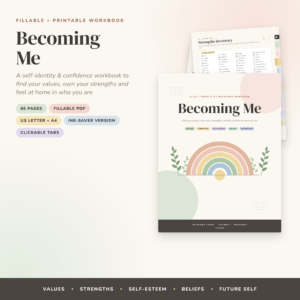
Becoming Me Self-Identity Workbook
Price: $3.99 | Best for: confidence, strengths and values together
A 66-page fillable and printable self-discovery workbook covering self-esteem, core values, strengths and confidence, listed as therapy worksheets. US Letter and A4 PDF. A good pick if your questions lean toward what you are good at.
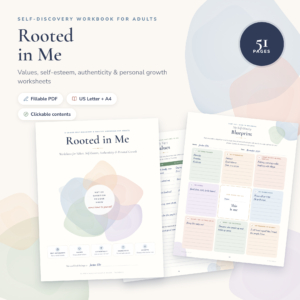
Rooted in Me Self-Discovery Workbook
Price: $4.99 | Best for: adults facing identity and boundary questions
A self-discovery workbook for adults with self-identity, values, self-esteem and boundaries worksheets, printable and fillable PDF in US Letter and A4. It fits readers whose questions about themselves are tangled up with how they treat other people.
Workbook Comparison
| Product | Format | Price | Best for | Link |
|---|---|---|---|---|
| Inner Compass Self-Identity Workbook | 79-page fillable PDF with 72 values cards | $3.59 | A simple start | View |
| Inner Compass Self-Discovery Workbook | 105-page fillable PDF with 72 values cards | $3.68 | More depth | View |
| Becoming Me Self-Identity Workbook | 66-page fillable PDF | $3.99 | Strengths and confidence | View |
| Rooted in Me Self-Discovery Workbook | Fillable and printable PDF for adults | $4.99 | Identity and boundaries | View |
If you only want one, the 105-page Inner Compass edition costs just nine cents more than the 79-page one. So unless you want the shorter read, the bigger version is the better value.
A Quick Example of the Questions in Action
Say you pick question 33: where do you say yes when you mean no? You write, “With my boss, always.” Then, because the second answer is closer to the truth, you add, “Because I am scared of looking lazy.” Now look at question 41, what are you avoiding right now? You write, “Asking for a smaller workload.” Two questions, two minutes, and a pattern has appeared that you could not see this morning.
That is how these questions work together. One opens a door and another walks you through it. Do not worry about finding the perfect order. Follow whatever tugs at you, and let the answers lead to the next question.
Mistakes People Make With Self Discovery Questions
Treating answers as permanent. You are allowed to change your mind. Today’s answer is a snapshot.
Hunting for one big truth. There is no single hidden “real you” waiting under the layers. You are the sum of many small things, and some of them conflict. That is normal.
Using the questions to beat yourself up. If an answer exposes a flaw, note it and move on. The point is clarity, not a trial.
Doing it only in a crisis. People reach for these questions when life falls apart. Better to ask in calm weeks too, when you can think straight.
Ignoring heavy feelings. If a question stirs up grief or fear that will not ease, talk to a counselor or doctor. Workbooks are self-help tools, not therapy.
Frequently Asked Questions
What are good self discovery questions to start with?
Start with easy, concrete ones: what you loved doing as a child, what you lose track of time doing, and what you refuse to compromise on. Concrete questions warm you up for deeper ones about fears and values.
How many self discovery questions should I answer at once?
Three to five per sitting is plenty. Your mind needs space between sessions to connect ideas. Rushing through all sixty at once tends to produce shallow answers.
How often should I revisit them?
Many people repeat their favorites every six months or after a big life change. Compare the new answers with the old, and notice what shifted and what stayed put.
Do I need a workbook, or is a notebook enough?
A plain notebook works fine. A workbook adds structure, prompts and extras like values cards, which helps if you freeze in front of a blank page. Choose whichever you will actually use.
Are these questions a replacement for therapy?
No. They are a self-reflection tool. If you are dealing with trauma, depression or anxiety, please see a qualified professional. These questions can sit alongside therapy, but they do not replace it.
Start With Five Questions Tonight
Pick five from the list above, set a timer for fifteen minutes, and write without editing. If you want pages ready to go, the Inner Compass Self-Discovery Workbook gives you 105 pages and 72 core values cards for $3.68. The questions are free. The only cost is being honest, and that part pays you back.