Most coaches who try Facebook ads quit in the first two weeks. Not because ads don’t work. They quit because they spend $140, get nine clicks, hear nothing, and have no idea which part broke. Was it the copy, the audience or the page? Nobody knows.
That’s the real problem with Facebook ads for coaches. The ads themselves are simple. The tracking is where people fall apart. This guide gives you scripts to start from, a budget you can defend, and a tracker that tells you what to fix next.
| Product | Best for | Price | Link |
|---|---|---|---|
| Facebook Ads Kit for Coaches | Ad scripts, lead scoring and an Excel ads dashboard | $4.99 | View product |
| Prompt Studio 600 | AI marketing prompts for small business | $6.29 | View product |
| Rosewater Price Quote Template Kit | Sending a quote once a lead says yes | $3.97 | View product |
Why Facebook Ads for Coaches Fail Before They Start
Picture a life coach called Dana. She spends a weekend building an ad, boosts a post, and sets $10 a day. By Thursday she has 41 likes and no calls booked. She decides ads are for people with bigger audiences.
Dana didn’t fail at advertising. She skipped three decisions. She never picked one offer to sell. She never decided what a good lead looks like. And she never set a number that would tell her to stop or keep going.
Facebook ads for coaches work differently from ads for a pair of shoes. Coaching is a high trust purchase. Nobody hands over a few hundred dollars to a stranger because of one image. So the ad has one narrow job: get the right person to raise a hand. A form, a message, a booked call. Everything else happens after that, in conversation.
That changes how you write. You are not selling your coaching in the ad. You’re selling the next small step.
Pick One Offer Before You Spend a Dollar
Run one offer at a time. A free discovery call, a short workshop, a five day challenge, a downloadable checklist. Pick whichever you can actually deliver this month.
Here’s a quick test. Can you describe your offer to a stranger in one sentence without using the word “transform”? If you can’t, the ad can’t either. “A 20 minute call to map your next 90 days at work” beats “reach your full self” every time. People know what the first one is.
The audience question
Start broad on location and age, narrow on the problem. A career coach in Texas talking to people stuck in the same job for six years is more useful than an interest list with 40 hobbies on it. Let the ad copy do the filtering. If the first line names the problem, the wrong people scroll past, and that’s good. You don’t pay for clicks that were never going to book.
Facebook Ads for Coaches: Scripts That Get a Reply
The best Facebook ads for coaches tend to follow a short pattern. Say who it’s for. Name the problem the way they’d say it to a friend. Offer one small step. Tell them what happens after they click. That’s it.
Here’s a rough shape you can bend to your niche.
- Line one: call out the person. “Burned out manager who still checks email at 10pm?”
- Line two to three: name the frustration in plain words, and say you’ve helped people through it.
- Line four: the offer. “Book a free 20 minute call.”
- Line five: what happens next. “You’ll leave with one clear next step, even if we never work together.”
The last line matters more than people think. It lowers the risk. A cold stranger doesn’t know what a “free call” means. Is it a pitch? Is it an hour? Spell it out.
Write three versions of your coach ad, not one. One that leads with the problem, one that leads with a result, one that leads with a short story. Run them side by side with the same budget and let the numbers pick the winner. This is where a ready made script set saves a lot of staring at a blank box.
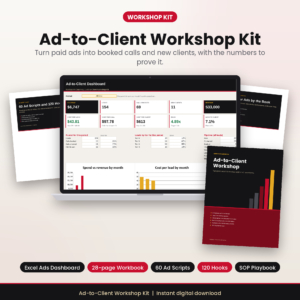
Facebook Ads Kit for Coaches
Price: $4.99 | Best for: coaches who want scripts and a tracker in one place
This kit comes with ad scripts, lead scoring and an Excel ads dashboard. The scripts give you a starting point so you’re not writing from scratch. The lead scoring helps you sort enquiries, and the dashboard is where your numbers live once the ads are running.
How Much to Budget for Facebook Ads as a Coach
Nobody can promise you a cost per lead, and anyone who does is guessing. Budgeting Facebook ads for coaches starts with your own numbers. It depends on your niche, your offer, your country and your creative. What you can do is set a test budget that’s small enough to survive and long enough to learn from.
A simple way to think about it. Decide what one new client is worth to you. Say your package is $600. Then decide how many leads it usually takes to land one client. If you don’t know yet, guess ten for now and correct it later. Ten leads at a price you can live with is your first target.
Here’s an example, with made up numbers so you can see the math. You spend $15 a day for 10 days, which is $150. You get 12 leads. That’s about $12.50 a lead. If one in ten leads becomes a client, you need ten leads per sale, so a client costs roughly $125 in ads. Against a $600 package, that works. If your package were $60, it wouldn’t.
Give the test enough time
Don’t judge on day two. Facebook needs a few days to learn who responds. And don’t change five things at once, because then you won’t know what helped. Change one thing, wait, look at the numbers, change the next one.
A rule for stopping
Write your stop rule before you start. For instance: “If I spend $100 and get fewer than 5 leads, I rewrite the ad.” Without a rule, you either bail too early or keep feeding a dead ad out of hope. Both feel awful, and both are avoidable.
Score Your Leads So You Stop Chasing the Wrong Ones
Not all leads are equal. Some fill in the form because they were curious. Some fill it in because they’ve been losing sleep over the problem for a year. Treating them the same wastes your calendar.
Lead scoring is just a way of putting a number next to each person. Keep it basic. Give a point for each of a few things: they answered your question honestly, they fit your price range, they have a deadline, they replied within a day. Add it up. Call the high scorers first.
It sounds fussy, but it fixes a real pain. Coaches often say, “I got 20 leads and nobody bought.” Often the truth is that 15 were never a fit. Scoring shows you that. And it also tells you something about the ad: if every lead scores low, the ad is attracting the wrong people, and you fix the copy rather than the budget.
Build a Simple Results Tracker You’ll Actually Open
A tracker doesn’t need to be clever. It needs to be open on your laptop on Friday afternoon. Here are the columns that earn their place.
- Week starting date
- Ad name (so you know which script ran)
- Amount spent
- Leads received
- Cost per lead (spent divided by leads)
- Calls booked
- Clients signed
- Cost per client
Eight columns. That’s the whole thing. The money columns tell you if you’re losing cash. The call and client columns tell you if the leads are any good. Most coaches only watch the first half, and that’s why they get fooled by cheap leads that never convert.
Spend ten minutes every week. Put the numbers in, look at which ad has the lowest cost per client, and kill the weakest one. Then write one new version to take its place. That loop, repeated for two months, is what working Facebook ads for coaches look like. It’s boring. It’s also how people end up with a steady stream of calls.
Use AI to Write More Variations, Then Edit Them
Once you know which angle is winning, you’ll need fresh versions, because ads get stale. Here AI tools can speed things up. Ask for ten headline options, five ways to say your offer, three short stories about a client problem with names changed. Then edit hard. Raw AI copy sounds like everyone else’s, and your audience can smell it.
If you want a stack of ready made prompts so you’re not inventing them each time, there’s a set aimed at small business owners.
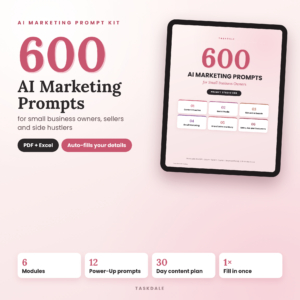
Prompt Studio 600: AI Marketing Prompts for Small Business
Price: $6.29 | Best for: small business owners who want marketing prompts ready to paste
Prompt Studio 600 is a collection of AI marketing prompts made for small business. It suits coaches who want help drafting ad variations, emails and posts without starting from an empty chat window. Use it to speed up the first draft, then rewrite in your own voice.
What Happens After the Click
An ad only starts the process. Reply fast, ideally the same day. A lead that waits three days is a lead that forgot why they clicked. Send a short, human message, ask one question, and offer two times for a call.
When a lead says yes to working together, send a clear quote. Don’t make people wait while you fiddle with a document. A tidy estimate makes you look organized, and for a coach selling trust, that counts.
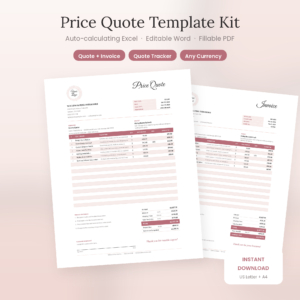
Rosewater Price Quote Template Kit
Price: $3.97 | Best for: coaches and freelancers who need a clean quote fast
This is an editable estimate template for Excel, Word and fillable PDF, with auto calculations, a matching invoice and a quote tracker. It’s a handy way to turn a good call into a clear next step in the same afternoon.
Compare the Tools at a Glance
| Product | Format | Price | Best for | Link |
|---|---|---|---|---|
| Facebook Ads Kit for Coaches | Ad scripts, lead scoring, Excel ads dashboard | $4.99 | Running and tracking your ads | View product |
| Prompt Studio 600 | AI marketing prompts | $6.29 | Writing more ad and email variations | View product |
| Rosewater Price Quote Template Kit | Excel, Word and fillable PDF | $3.97 | Quotes, invoices and quote tracking | View product |
Frequently Asked Questions
How much should a coach spend on Facebook ads to start?
For most coaches, Facebook ads start with an amount you can lose without panic, spread over at least 10 days. Many coaches test with $10 to $20 a day, then adjust once they see real numbers. Decide your stop rule first, such as a spend limit with a minimum lead count, so one weak week doesn’t decide everything for you. Then review the numbers weekly.
Do I need a website to run Facebook ads for coaches?
Not always. Lead forms inside Facebook or a simple booking page can work for a first test. What you do need is one clear place for people to take the next step, and a way to reply quickly when they do. Speed matters more than polish here.
What should a coaching ad say?
Name who it’s for, describe their problem in their own words, offer one small step, and say what happens after they click. Keep claims honest and specific. Don’t promise income or guaranteed results, and follow Facebook’s ad rules for your topic.
How do I know if my ads are working?
Look past clicks and likes. Track cost per lead, calls booked, clients signed and cost per client every week. If leads are cheap but nobody books, the ad is attracting the wrong people. If leads are costly but they buy, you may only need a better offer or script.
How many ad versions should I test?
Begin with three coach ads that differ in one big way, such as problem led, result led and story led. Give each the same budget. After a week or two, drop the weakest and write a fresh challenger to replace it. Repeat that cycle every couple of weeks.
So, the short version: pick one offer, write three scripts, set a stop rule, and track eight columns every Friday. If you’d rather not build all that from zero, the Facebook Ads Kit for Coaches gives you scripts, lead scoring and a dashboard for $4.99. Start there and run your first ten day test this month.