The vet’s receptionist asks when your dog last had her rabies shot. You freeze. It was last spring, maybe? There’s a receipt somewhere. Possibly in the car, possibly in a drawer, possibly gone. A good pet health record ends that scramble, and it costs less than a bag of treats to set up.
This guide shows what to put in a pet health record, how to keep it up to date without hating it, and which printable binder from Taskdale makes the whole thing easy. Dogs, cats, rabbits, it works for all of them.
Quick picks
| Product | Best for | Price | Link |
|---|---|---|---|
| PawNest Pet Care Planner | A full pet health record binder with vaccine, medication, vet and weight trackers | $1.19 | View product |
| Good Dog Training & Care Planner | Dog owners who also want a training planner | $15.00 | View product |
Why a pet health record is worth the ten minutes
Most of us keep our own medical details in our heads and in an app. Pets can’t do that. They have no login, no patient portal that follows them from clinic to clinic. If you move house, change vets, book a boarding stay or adopt a second animal, the paperwork is on you.
A simple pet health record fixes this. It is one place where the facts live: which vaccines, which dates, what medicine, what dose, what weight, which vet said what. When something goes wrong at 9 pm on a Sunday, you are not digging through email for a PDF.
Picture the boarding kennel asking for proof of vaccines the night before your trip. With a binder on the shelf, you grab it, copy the dates, done. Without one, you are phoning the clinic first thing and hoping they open early.
And here’s the part people miss. A record is not only for emergencies. It also shows patterns. If your cat has lost a little weight over three visits, you’ll see it on paper long before you’d notice it on the sofa.
What goes in a good pet health record
You do not need forty pages of forms. You need a handful of sections, filled in honestly. Here is a good core set to start with.
Basic profile
Name, birthday or best-guess age, breed or mix, colour and markings, microchip number if there is one, and your vet’s phone number. If your pet is a rescue, write down what you do know and leave the rest blank. Blank is fine.
Vaccines
List each vaccine, the date given, and the date the next one is due. Boarding places, groomers and trainers often ask for this exact list. Keep it in a table so the dates line up, because dates scattered through a diary are impossible to scan.
Medications and treatments
Write the name, the dose your vet gave you, how often, and the start and stop dates. Flea and worm treatments belong here too. People forget the monthly ones more than any other, which is why a tracker with check boxes beats a good memory every time.
Vet visits
One line per visit: date, reason, what the vet said, what you were told to do next. Add the cost if you like. It makes the end-of-year total less of a shock, and sometimes a pleasant surprise.
Weight
A monthly weigh-in takes two minutes. Weight is one of the easiest things to track and one of the first things a vet asks about. Jot the number, the date, and move on.
That’s a workable pet health record. Everything else is a bonus.
Paper binder, app or spreadsheet?
Fair question. Paper is a strong fit for this job, and here is why.
An app is great until you change phones, forget the password or the company shuts down. A spreadsheet is fine, but it lives on a laptop and nobody opens a laptop at the vet’s front desk. A paper binder sits in a drawer, goes in the car on road trips, and can be handed to a pet sitter without any setup. Anybody can read it.
Printable binders also let you reprint a page when it fills up. No need to buy a whole new book. If your dog chews the cover (it happens), you print another one.
That said, do what you’ll actually do. If a phone note works for you, use it. The only bad system is the one you stop using in week two.
How to set up a pet health record in one evening
Block out about an hour. Put the kettle on. Here is an order that works well.
- Gather every scrap: vaccine cards, receipts, adoption papers, emails from the clinic.
- Print your binder pages and punch holes, or open the fillable PDF on your computer.
- Fill in the profile page first. It is the easy win and builds momentum.
- Copy vaccine dates from the cards into the vaccine tracker.
- Add current medications with doses exactly as written on the label.
- Log today’s weight, even if you have to guess with a bathroom scale (weigh yourself, then yourself holding the pet, then subtract).
- Slip the paper receipts into a pocket or folder behind the pages.
That’s it. Next vet visit, you add one line. Next month, you add one weight. The record grows slowly, which is exactly how you want it to grow.
PawNest: a ready-made pet health record binder
You can build all of this from a blank notebook. But ruled lines don’t give you a vaccine table, and you will spend your first evening drawing boxes. PawNest does the boxes for you.
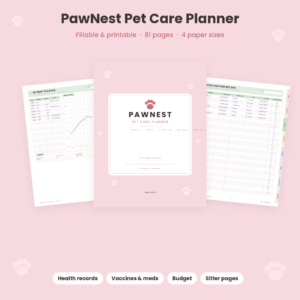
PawNest Pet Care Planner
Price: $1.19 | Best for: owners who want one printable pet health record binder
PawNest is a printable and fillable pet health record binder with vaccine, medication, vet and weight trackers. It comes in US Letter, A4, A5 and Half Letter sizes, so you can print it to fit the binder you already own. At this price it is hard to justify using sticky notes instead.
Notice the word fillable. You can type into the PDF on your computer, print it, and still scribble updates by hand later. Mixing both is perfectly normal. Plenty of people type the permanent facts and pen in the changing ones.
The four trackers named in the title, vaccines, medication, vet visits and weight, cover pretty much everything on the list above. So if you followed the section on what to include, PawNest is basically that list with the tables already drawn.
Keeping your pet health record up to date
Setting it up is the easy part. Keeping it current is where most people fall off. A few habits help.
Update it in the car park
The minute you leave the vet, before you start the engine, write down what happened. You will remember it perfectly now and vaguely tomorrow. Keep a pen in the binder or the glove box.
Tie it to something you already do
Weigh your pet on the first of each month. Check the medication tracker when you refill the food bowl on Sunday. A habit with an anchor survives. A habit with a vague intention doesn’t.
Photograph the paperwork
Take a quick phone photo of any vet certificate before you file it. Belt and braces. If the original goes missing, you still have the dates.
Review it twice a year
Pick two dates, say your birthday and six months later. Flip through the binder. Is anything overdue? Does any medication need a refill? This five-minute review catches the things that slip through the cracks.
Mistakes that make a pet health record useless
A few patterns waste the effort.
First, writing “vaccinated” without a date. A date is the entire point. Second, recording a medicine name but not the dose. Next month you won’t remember whether it was half a tablet or a whole one. Third, keeping three versions: one on a fridge note, one in a phone and one in a folder. They drift apart. Choose one master and keep it there.
Fourth, never writing down the vet’s advice. When a vet says “keep an eye on that lump”, write the date and where the lump is. Then you can say, truthfully, how long it has been there.
Last, treating the record as a chore for when you “have time”. You won’t have time. Do it in tiny bites.
One honest note: this article is general information and not veterinary advice. Your vet decides what your pet needs. The record simply helps you pass the right facts to them.
Dog owners: add a training and care planner
If you share your home with a dog, there’s a second kind of record worth having. Health is one half. Behaviour and routine are the other. Where did you leave off with loose-lead walking? Which socialization outings have you done? That sort of thing doesn’t fit in a vaccine table.

Good Dog Training & Care Planner
Price: $15.00 | Best for: dog owners who want training and care in one place
This is a printable dog training planner supplied as a US Letter and A4 PDF. It pairs well with a health binder: one tracks the vet side, the other tracks the training side. It costs more than PawNest, so it makes the most sense if you are actively training a puppy or a newly adopted dog.
If you are raising a puppy right now, our puppy training schedule walks through the first eight weeks and pairs nicely with this planner.
A small tip on cost. Vet bills sneak up on people, and a record that notes each visit’s reason and price makes the pattern obvious. Say you spot three ear checks in a single year. That is worth raising with the vet, and a page of notes makes that conversation easy.
Which one should you pick?
Here is the straight comparison.
| Product | Format | Price | Best for | Link |
|---|---|---|---|---|
| PawNest Pet Care Planner | Printable and fillable, US Letter, A4, A5, Half Letter | $1.19 | Vaccine, medication, vet and weight tracking for any pet | View product |
| Good Dog Training & Care Planner | Printable PDF, US Letter and A4 | $15.00 | Dog training and care planning | View product |
My honest take: start with PawNest. It is cheap, it covers the health side for any animal, and you will use it every month. Add the Good Dog planner later if training becomes a project.
Frequently asked questions
What should a pet health record include?
At minimum: a basic profile, vaccine names with dates given and due dates, medications with doses, vet visit notes, and regular weight readings. Add microchip details and your vet’s phone number. Keep receipts or certificates in a pocket behind the pages so proof is always close.
How long should I keep my pet’s health records?
Keep them for your pet’s whole life, and a little after if you can. Older notes help a new vet understand history, and past vaccine dates often matter for boarding or travel. Paper takes little space, and a phone photo of key pages gives you a backup.
Can I use one binder for several pets?
You can, but separate sections work better. Print one set of pages per animal and divide them with tabs. That way each pet has its own vaccine table and weight log, and you never wonder whose medication you just wrote down.
Is a printable pet health record better than an app?
It depends on you. Paper never needs a password, works without signal and can be handed to a sitter. Apps send reminders. Many people use both: the binder as the master copy and phone alerts for due dates.
How often should I weigh my pet?
Monthly is a practical rhythm for most owners, and puppies or kittens are often weighed more often. Your vet can tell you what suits your animal. The main thing is to write each number down with the date so changes show up.
Your next step
So, the short version. Gather your paperwork tonight, print a binder, and fill in the profile and vaccine pages before bed. That alone puts you ahead of most pet owners. If you want the tables already drawn for you, grab PawNest for $1.19 and start your pet health record this evening.