The scale said 154 on Monday, 157 on Wednesday and 155 on Friday. Did you gain, lose or neither? Honestly, none of the above. Single numbers lie. A good weight loss tracker printable turns those jumpy numbers into a pattern you can read, and that pattern is what tells you whether your plan is working. This guide shows you how to log progress in a way that means something, and it compares five printable trackers from Taskdale that cost between $1.29 and $2.19.
General information only, not medical advice. Talk to your doctor before you change your eating or exercise, especially if you have a health condition.
Quick picks
| Product | Best for | Price | Link |
|---|---|---|---|
| Scale Story 52-Week Weight Loss Tracker Printable | A full year of weekly weigh-ins and a progress graph | $1.67 | View |
| Steady Steps Weight Tracker Printable Kit | A low-cost weight tracker kit | $1.99 | View |
| Step On Weigh-In Journal | A simple weigh-in journal | $1.29 | View |
| Rosewater Printable Weight Loss Planner | A pounds lost chart plus journal pages | $2.19 | View |
| Pound Path Weight Loss Challenge Printable | Short challenges with challenge boards | $1.88 | View |
Why Most Weight Loss Tracker Printable Pages Get Abandoned
Here is the usual story. Someone downloads a pretty page, writes the date and a number for four days, then stops. Why? Because the page asked for too much, or because the number made them feel bad.
A tracker that works asks for very little and shows you something useful in return. One weight, one date, one short note. That is it. When you see a line moving over several weeks, you stop reacting to a single bad morning. You start thinking in trends, which is where the good decisions come from.
Think about the last tracker you quit. Was it too long? Too pretty to write on? Did it ask for calories, steps, mood and water every single night? Most people can name the exact page where they gave up. Learn from that page, and pick something lighter this time.
So before we look at products, let us fix the habit. The paper is the easy part.
How to Log Weight Loss Progress So the Numbers Mean Something
These rules are simple, and they work with any printable weight loss tracker.
- Weigh at the same time. First thing in the morning, after the bathroom, before breakfast. Same scale, same spot on the floor.
- Pick a rhythm. Weekly is calmer. Daily gives more data but more worry. Choose one and stay with it.
- Write a short note. Late night out, bad sleep, a hard workout. Three words is enough.
- Look at four weeks, not one day. Circle the trend, not the dot.
Try this for a month before you judge your plan. If the line is flat for four weeks while you followed your plan, that is real information. Then you can change one thing. Not five.
Add a second kind of number
Weight is only one signal. Some people also track how their clothes fit, how they sleep or how many walks they took. A page with room for a note lets you record these without a separate system. If the scale stalls but your jeans feel looser, you will want that written down.
Picking the Right Weight Loss Tracker Printable for Your Routine
The best tracker is the one that matches how often you want to check in. Do you like a long view, a short sprint or a journal with space to talk to yourself? Here are the Taskdale options, and what each one is good at.
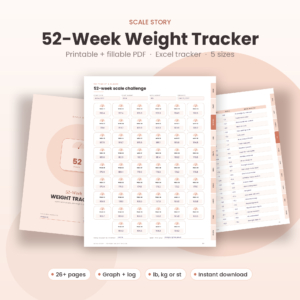
Scale Story 52-Week Weight Loss Tracker Printable
Price: $1.67 | Best for: a year-long weekly habit
A 52-week weight loss tracker with a fillable PDF weight log, a progress graph and an Excel tracker. It comes in Letter, A4, A5, Half Letter and Classic sizes. Fifty-two weeks is a long view, which suits anyone who wants to see the slow, honest shape of change.
The progress graph is the feature that matters most. When you plot a point each week, you see the line instead of the noise. The fillable PDF means you can type your numbers on a laptop if you prefer, and the Excel tracker gives you a second way to record them.
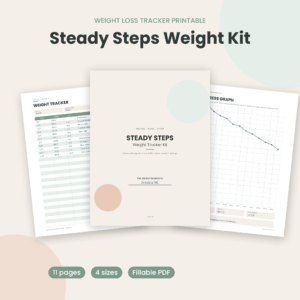
Steady Steps Weight Tracker Printable Kit
Price: $1.99 | Best for: an easy, affordable start
A printable weight tracker kit. The listing keeps it simple, which is the point: a no-fuss way to start logging your weight without a pile of extra pages to fill in.
If you have never kept a tracker before, a plain kit is a smart first move. You can always add more pages later.
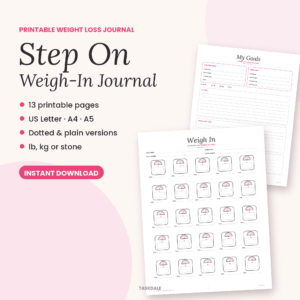
Step On Weigh-In Journal
Price: $1.29 | Best for: a weigh-in routine you can keep
A printable weight loss tracker built as a weigh-in journal. It costs $1.29 and puts the focus on the act of weighing in and writing it down, rather than on a big planner.
Think of this one as a diary for the scale. The ritual of writing it in turns a number you dread into a record you control.
If you want more than a weigh-in page
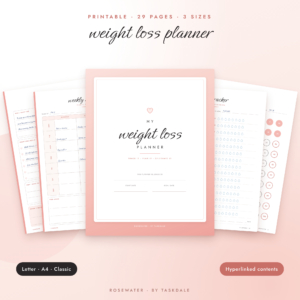
Rosewater Printable Weight Loss Planner
Price: $2.19 | Best for: tracking plus reflection
A 29-page weight loss tracker, journal and pounds lost chart. It comes in US Letter, A4 and Classic sizes. The journal pages give you room to write about how the week felt, not just what the scale said.
For a short, focused push, take a look at Pound Path. It is a 17-page fitness tracker kit with challenge boards, a weigh-in log and a habit tracker, in US Letter, A4 and A5. It costs $1.88.
Side-by-side comparison
| Product | Format | Price | Best for | Link |
|---|---|---|---|---|
| Scale Story | Fillable PDF, graph and Excel tracker, 52 weeks | $1.67 | Long-term weekly logging | View |
| Steady Steps | Printable kit | $1.99 | Starting simply | View |
| Step On | Printable weigh-in journal | $1.29 | A daily or weekly weigh-in habit | View |
| Rosewater | Printable, 29 pages | $2.19 | Tracking with journal pages | View |
| Pound Path | Printable, 17 pages | $1.88 | Short challenges | View |
Reading Your Weight Loss Tracker Printable Without Panic
Once you have a few weeks of data, resist the urge to read meaning into every wiggle. Bodies hold water. A salty dinner can add a pound by morning, and it will not be fat. That is normal, and it is exactly why a log beats memory.
Do this each week. Add your number, glance at the last four, and write one line. What helped? What got in the way? After a month you will see your own patterns. Maybe weekends are tougher. Maybe stress shows up before a rough week. Once you can name it, you can plan around it.
And if a number upsets you, step away from the page for a day. The page is a tool, not a judge.
Small Setup Tricks That Make Tracking Stick
Print your tracker on regular paper first. Use a cheap pen on a clipboard or tuck it in a folder in the bathroom cabinet. Put the pen on the shelf, not in a drawer. If you have to hunt for it, you will skip the day.
Pick one cue. Weigh, step off, write. Same order each time. Habits grow when the steps are the same, so do not reinvent the routine on a whim.
Finally, print a few spare sheets. A coffee stain or a torn page should not end your streak. That is the beauty of printables: you own the file, so one mishap costs you a few cents of ink.
A quick note on mood
If tracking brings up strong feelings or stress around food and your body, pause and talk to a professional. A tracker should help you feel more in control, not less.
Choosing a paper size
It sounds boring, but size matters. Scale Story comes in Letter, A4, A5, Half Letter and Classic, so you can print a full sheet for a clipboard or a small page for a binder you carry around. Rosewater offers US Letter, A4 and Classic. If you use a ring planner, check that the size matches before you print twenty pages.
Think about where the page will live. A bathroom wall favours a full sheet you can read from a distance. A bedside table favours something small. Match the page to the place and you will use it more often, simple as that.
A Four-Week Plan for Your First Tracker
Do not try to be perfect. Try to be present. Here is a gentle way to start.
Week one: just weigh and write. Skip every extra page. Record one number and one short note. If you only do that, you have won the week.
Week two: add one habit. Maybe a daily walk or a glass of water at lunch. Tick it on the page. Keep the extras tiny so they do not crowd out the weigh-in.
Week three: read the pattern. Look at your three numbers so far. Is there a day that always runs high? Does sleep show up in your notes? You are not judging, you are collecting clues.
Week four: change one thing. Pick the smallest tweak that fits what you noticed, like an earlier dinner or a Sunday meal plan, and give it another four weeks. Then compare the lines.
That slow pace may feel dull. Good. Dull is what keeps people logging past the first month, when the excitement has worn off and only the habit is left.
Mistakes That Make a Weight Tracker Useless
The first mistake is logging only on good days. A tracker full of lucky weeks tells you nothing, so write the rough ones too. The second is switching scales halfway through. Different scales disagree by a pound or two, and then your line has a jump that means nothing. Keep one scale.
The third mistake is chasing a date. A wedding in six weeks is a real goal, but a tracker cannot force the line to bend. Use it to see what is actually happening, then adjust your plan, not your expectations. And the fourth? Comparing your page to a stranger’s. Your line is yours alone, so cover up everyone else’s.
Frequently asked questions
What should a weight loss tracker printable include?
At minimum, a date, a weight and a place for a short note. A progress graph or chart helps you see the trend, and extra pages for measurements or habits are a bonus. Scale Story includes a progress graph, while Rosewater adds a pounds lost chart and journal pages.
How often should I use a weight loss tracker printable?
Weekly works well for most people, since it smooths out daily ups and downs. Daily weigh-ins give more data but can feel stressful. Choose the rhythm you can keep for at least a month, then judge your progress by the four-week trend.
Are printable weight trackers better than apps?
Neither is better for everyone. Paper has no notifications and is easy to see on a wall or fridge. Apps are always with you. If you often forget to open apps, a printed page in a spot you walk past daily can be easier to keep up.
Can I type into these printables instead of writing by hand?
Some can. Scale Story is a fillable PDF, so you can type your numbers into the weight log on a computer, and it also includes an Excel tracker. Check each product page for the exact formats before you buy.
Do I need a printer for a weight loss tracker printable?
You can print at home or take the file to a copy shop. The files come in several paper sizes, such as US Letter and A4. Some, like Scale Story, are fillable, so you may be able to use them on screen without printing.
So, the short version: choose one tracker, weigh at the same time, and write one line each week. If you want a full year of weekly logging with a graph, start with Scale Story for $1.67.